




Choosing between an interior design and fitout company and separate contractors shapes how your project moves from the first sketch to final handover. One route places design and execution under a single team, while the other lets you appoint each specialist and coordinate them yourself. This guide compares both routes on coordination, workflow, cost, control, and risk, so you can match the model to your project in the UAE.
What Is the Difference Between an Interior Design and Fitout Company and Separate Contractors?
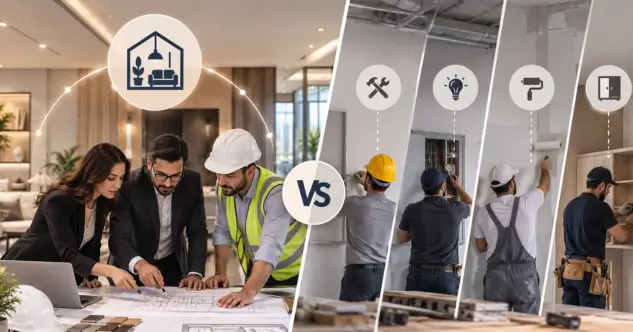
The main difference lies in how design and execution responsibilities are structured and managed throughout the project.
An interior design and fitout company typically provides:
- A connected approach to design and on-site execution.
- Coordination between designers, technical teams, and fitout specialists.
- Centralized responsibility for project decisions.
- A direct transition from approved designs to implementation.
Working with separate contractors typically involves:
- Selecting different providers for design and fitout.
- Managing responsibilities across multiple independent teams.
- Flexibility in choosing specialists for individual project stages.
- More involvement from the client or project manager in passing information between parties.
Each route suits a different type of project, and the right choice depends on project complexity, the level of coordination required, and how much involvement you want in managing providers.
Fit Out, Design and Build, and Turnkey: Three Delivery Models in the UAE
Commercial and residential interiors in the UAE are usually procured through one of three models, and each one assigns design, execution, and risk differently:
| Model | Who Designs | Who Builds | Client Role | Best Suited For |
| Fit out (design-bid-build) | Independent designer or consultant | Contractor selected through tender on finished drawings | Coordinates designer and contractor | Clients wanting full control over design and finishes |
| Design and build | The same company | The same company | Approves stages under one contract | Projects needing speed and one point of responsibility |
| Turnkey | The same company | The same company, including furniture and handover | Receives a ready-to-use space | Clients wanting minimal day-to-day involvement |
The separate contractors route matches the first model, while an interior design and fitout company typically works under the design and build or turnkey model.
How Delivery Models Connect to Interior Design in Dubai and Abu Dhabi
The delivery model you choose decides how faithfully a design concept survives the journey to site, since every handover between teams is a point where details can shift. Villas, apartments, offices, and retail spaces across the UAE draw on the same market of designers, suppliers, and approval routes described in our guide to interior design in Dubai and Abu Dhabi. Understanding that market first helps you judge whether one integrated team or several specialists will protect your design intent better.
How Does Each Approach Affect Project Coordination?

The way a project team is structured directly affects communication, responsibilities, and the coordination of design and fitout activities.
| Coordination Area | Interior Design and Fitout Company | Separate Contractors |
| Communication | Information moves directly between teams within the same project structure. | Communication passes between several independent parties. |
| Responsibilities | Design and fitout responsibilities sit with one company. | Responsibilities are divided between different providers. |
| Design Changes | Adjustments are reviewed with design and execution requirements together. | Changes require extra coordination between the designer and contractors. |
| Technical Coordination | Technical requirements are considered alongside design decisions. | Each team must keep drawings and requirements aligned with the others. |
| Authority Approvals | One team prepares drawings and follows submissions through to completion. | The designer prepares drawings while the contractor handles site permits and inspections. |
| Defects After Handover | One company handles snags and defects under one liability period. | Defects may need tracing back to either the design or the execution. |
| Project Management | Fewer parties simplify overall coordination. | The client or project manager takes a more active coordination role. |
Both approaches work when managed properly, and the integrated structure reduces the number of communication points, while separate contractors need a structured coordination process to keep every party aligned.
How the Project Workflow Runs Under Each Approach
The sequence of stages differs sharply between the two routes, and that sequence has the largest effect on how long the project takes.
Separate Designer and Contractor
Each stage waits for the previous one to finish, which gives the client a clear checkpoint before moving forward:
- The designer develops the concept, layouts, and material specifications.
- Construction drawings are completed and issued for tender.
- Two or three contractors submit bids on the same drawings.
- The client selects a contractor and signs a separate contract.
- Construction starts once the contract is in place.
Design and Build
Stages overlap because one team controls the whole programme:
- Concept and layout development start alongside early cost planning.
- Procurement of long-lead items begins while detailed drawings are finalized.
- Authority submissions run in parallel with design completion.
- Site works start as soon as approvals are issued.
This overlap is where the time advantage comes from, and on commercial floors it matters most for tenants with fixed lease dates, which is why many office fit out companies deliver projects under the design and build model.
How Do the Two Approaches Affect Project Costs?

The choice between an integrated company and separate contractors influences how project costs are planned, monitored, and adjusted during execution. According to Architecture, Structures and Construction, only 30% of residential construction projects in the UAE meet their cost and schedule targets, with design changes identified as a leading contributing factor.
Key cost considerations include:
- Multiple contracts: Separate contractors bring different quotations, scopes, and payment structures, requiring closer budget management across several providers.
- Scope changes: Design or technical changes during execution affect costs, especially when they require adjustments across multiple contractors or approved work.
- Rework: Gaps between design requirements and on-site execution lead to additional work or material changes.
- Budget visibility: An interior design and fitout company provides a single view of design and execution costs, making it easier to track how each decision affects the total budget.
- Tender pricing: Separate contractors bidding on the same drawings create direct price competition, while an integrated company may add a coordination margin.
- Bundled design fees: Offers of “free design” under design and build usually include the design cost inside the construction price.
The final cost depends on the project scope, specifications, materials, changes, and how effectively the project is managed.
Which Approach Gives You Better Control Over the Project?

The better approach depends on how much direct involvement you want in managing the project.
Choose an integrated approach if you prefer:
- One company managing design and fitout responsibilities.
- Fewer individual contractors to oversee directly.
- A centralized process for approvals and project decisions.
- Less day-to-day involvement in managing different providers.
Choose separate contractors if you prefer:
- Selecting each designer, specialist, or contractor individually.
- Managing separate contracts and scopes of work.
- Direct involvement in decisions at each project stage.
- An independent designer reviewing the contractor’s work on your behalf.
An interior design and fitout company suits clients who want centralized project management, while separate contractors give direct involvement and independent oversight to clients who want to manage providers themselves.
When Should You Choose an Interior Design and Fitout Company?

An interior design and fitout company suits projects where design and execution need to move together under one integrated approach. This option works particularly well when:
- The project is complex: Detailed interiors, custom elements, or multiple technical requirements benefit from one integrated team.
- You want one point of responsibility: A single company manages design and fitout, leaving you with one contract to follow.
- You prefer limited day-to-day involvement: The company coordinates its own designers, technical teams, and site workers.
- The design requires careful execution: Bespoke finishes, joinery, lighting, and detailed features need close attention from drawing to installation.
- The timeline is tight: Overlapping design, procurement, and approvals shortens the overall programme.
The decision should reflect the project’s complexity, your preferred level of involvement, and how you want responsibilities divided. If you are also comparing potential partners, our guide on the best interior design company explains how to evaluate them.
When Separate Contractors Make More Sense
Separate contractors suit projects where control, independent review, or price competition carry more weight than speed. This route fits best when:
- The design is already complete: Finished drawings can go straight to tender.
- Many stakeholders must approve: Hospitality and healthcare projects often involve several approving parties at each stage.
- You have an in-house project manager: An experienced manager can coordinate the designer and contractor effectively.
- Price comparison is a priority: Several contractors bidding on identical drawings give a clear cost benchmark.
- You want independent oversight: The designer checks site work against the approved design.
How to Confirm a Company Truly Delivers Design and Fitout
Many firms describe themselves as design and build providers while outsourcing one side of the work, so verify the claim before signing. Established fit out companies in Dubai & Abu Dhabi can show each of the following:
- A contracting or fit-out trade licence: A design consultancy permit alone does not cover site execution.
- In-house execution teams: Joinery, MEP, and site supervision handled by the company’s own staff.
- Completed projects delivered end to end: Work where the same firm produced the design and handed over the finished space.
- One contract and one liability period: Defects covered by the same company that designed and built the space.
- Clear design and build pricing: A breakdown that shows the design fee and execution cost separately.
Why Choose G&M as Your Interior Design and Fitout Company?
G&M delivers interior design and fitout through one team based in Abu Dhabi, combining creative design, technical planning, material selection, and site execution under one contract. What this means for your project:
- AI space simulation and lighting analysis: Layouts and lighting are tested digitally before any site work begins.
- In-house electromechanical contracting: MEP works are delivered by G&M’s own technical division.
- Direct sourcing of finishing materials: High-end building materials and interior finishes supplied through G&M.
- One point of responsibility: Design, approvals coordination, execution, and defects handled by the same team.
- Residential and commercial experience: Villas, apartments, offices, and retail spaces across Abu Dhabi and Dubai.
Planning an interior project in the UAE? Explore our Interior & Exterior Design Services in Abu Dhabi & Dubai.
Conclusion
Choosing between separate contractors and an interior design and fitout company depends on your project requirements and how involved you want to be in managing providers. Separate contractors offer independent oversight and price competition, while an integrated approach offers speed and one point of responsibility. The right choice is the one that matches your project’s complexity, priorities, and preferred management style.
contact us
Adress: Abu Dhabi – Al Wahda Area
Phone: +971 2 446 9100
Phone: +971 50 4850 820
Email: info@gandm.ae
FAQ
Can One Company Handle Both Interior Design and Fitout?
Yes. Design and build companies manage design development and fitout execution within the same team and under one contract.
Is an Interior Design and Fitout Company Suitable for Both Residential and Commercial Projects?
Yes, depending on the company’s expertise. Villas, apartments, offices, retail spaces, and hospitality projects can all be delivered under the design and build model.
Is design really free under a design and build contract?
Design cost is usually included in the overall construction price. Ask for a breakdown that separates the design fee from execution costs before signing.
Can I hire one company for design only and tender the build separately?
Yes. Many integrated firms accept design-only appointments, and you can then tender the finished drawings to several contractors.
Who is responsible for defects after handover?
Under design and build, the same company handles all defects during the liability period. With separate contractors, responsibility depends on whether the defect comes from the design or the execution.