




Choosing the right fit out contractors in Dubai and Abu Dhabi can directly affect how efficiently an interior project moves from approved designs to a completed, functional space. Their role extends beyond construction work to coordinating trades, managing site activities, controlling quality, and ensuring that technical and finishing requirements are executed correctly across every phase of the project.
Whether the project involves an office, retail space, restaurant, or residential property, understanding what a fit out contractor does helps you evaluate potential contractors more effectively. This guide covers the key responsibilities of fit out contractors, how they manage project execution, and what to consider when choosing the right contractor for your project.
What Is a Fit Out Contractor?

A fit out contractor is responsible for executing the interior works required to transform a space into a functional environment ready for its intended use. The contractor works from approved designs and project specifications, coordinating construction activities, technical requirements, materials, trades, and finishing works on site.
In Dubai and Abu Dhabi, the distinction between a design consultancy and a fit out contractor is a regulatory one. A design licence permits drawings only. On-site execution requires a separate fit out contracting licence. From January 2026, all fit out contractors operating in Dubai must also be registered within the Dubai Municipality Contractor Register under Law No. 7 of 2025. This matters when evaluating who is legally qualified to carry out physical works on your project.
Fit out contractors work across offices, retail spaces, hospitality projects, and residential properties. Their role is primarily execution-focused, ensuring that design and technical requirements are translated accurately into completed interior spaces while maintaining coordination, quality, and project requirements throughout.
What Services Do Fit Out Contractors Provide?

Fit out contractors provide the construction, technical, and finishing services required to prepare an interior space for use. The exact scope varies by project, but commonly includes:
- Site preparation: Stripping out existing finishes, assessing site conditions against approved drawings, and preparing the shell for fit out works.
- Partitions and ceilings: Installing internal partitions, suspended ceilings, and other structural interior elements that define the layout of the space. Ceiling works cannot proceed before MEP services above the ceiling line have been coordinated and signed off.
- MEP coordination: Coordinating mechanical, electrical, plumbing, and HVAC requirements with the interior design and site conditions. MEP coordination is where project complexity most often increases. Joinery dimensions depend on confirmed wall and floor conditions, and ceiling installation cannot begin before MEP routing above the ceiling line is resolved.
- Electrical and lighting works: Installing lighting circuits, power distribution boards, outlets, and related electrical infrastructure according to project requirements and DEWA clearance in Dubai or ADDC clearance in Abu Dhabi.
- Flooring and finishes: Installing flooring, wall finishes, paint, and finishing materials specified in the approved drawings.
- Joinery works: Producing and installing custom elements such as reception counters, storage units, cabinetry, and built-in features. Joinery shop drawings must be coordinated against confirmed wall and floor conditions before fabrication begins, as post-fabrication adjustments affect both cost and programme.
- Furniture and fixture installation: Coordinating and installing furniture, fixtures, and equipment where included within the contractor’s scope.
- Testing and final handover: Inspecting completed works, addressing outstanding items, and preparing the space for authority sign-off and final handover.
For specialized projects such as workplaces, the scope may also involve requirements specific to employee movement, meeting areas, workstations, technology integration, and daily operations. You can explore these requirements in more detail in our guide to Office Fit Out Companies.
Fit Out Contractor vs. Main Contractor: What’s the Difference?

A fit out contractor and a main contractor can both be involved in construction projects, but their responsibilities focus on different stages and scopes of work.
| Aspect | Fit Out Contractor | Main Contractor |
| Main Focus | Interior construction, technical coordination, finishes, and installations | Overall building construction and major structural works |
| Typical Scope | Partitions, ceilings, flooring, MEP coordination, lighting, joinery, and finishes | Structural works, building envelope, major construction activities, and overall site coordination |
| Project Stage | Commonly involved once the space is ready for interior fit out | Often involved from the main construction stages |
| Primary Objective | Transform the interior into a functional, finished space | Deliver the building or broader construction scope |
| Specialist Coordination | Coordinates interior trades, suppliers, finishes, and fit out requirements | Coordinates the wider construction team and major subcontractors |
The distinction can vary depending on the project and contractual structure. On some projects, the main contractor may manage fit out works directly or appoint specialist fit out contractors as subcontractors. On others, a fit out contractor is appointed separately once the main construction works reach the required stage.
The Fit Out Market in Dubai and Abu Dhabi
According torecent research, the UAE interior fit out market is valued at USD 10 billion, with Dubai and Abu Dhabi as the dominant cities attributed to their status as economic and cultural hubs. The market is projected to expand from USD 3.02 billion in specialist contractor revenue in 2025 to USD 4.59 billion by 2031, representing a forecast CAGR of 7.23%.
This level of activity means both cities have a wide range of fit out contractors operating at different scales and specialisations, which makes the selection process more important, not less. With over 1,500 registered fit out companies operating in the UAE, evaluating contractors on technical capability and scope clarity is the more reliable basis for selection than price alone.
How Do Fit Out Contractors Manage a Project?

Fit out contractors manage a project by coordinating the people, materials, technical requirements, and site activities needed to move from approved plans to final handover. Effective project management helps keep different trades aligned while maintaining quality, schedule, and project requirements.
- Reviewing the project scope: Confirming approved drawings, specifications, site conditions, technical requirements, and responsibilities before work begins.
- Planning and scheduling: Organizing the sequence of works, key milestones, procurement, and site activities to reduce delays and conflicts between trades.
- Coordinating technical works: Aligning MEP systems, partitions, ceilings, lighting, joinery, and finishes so that different elements can be installed in the correct sequence. MEP subcontracted without direct coordination from the fit out contractor is the leading cause of programme delays on interior projects in Dubai.
- Managing procurement: Coordinating material orders, suppliers, lead times, and deliveries according to the project schedule. Custom joinery, specialist lighting, and imported finishes often carry lead times of several weeks and must be ordered before site works reach the installation stage.
- Supervising site execution: Monitoring contractors and trades to ensure work follows approved drawings, specifications, and quality requirements.
- Monitoring quality and progress: Inspecting completed works, tracking progress against the schedule, and addressing issues that may affect execution.
- Final inspection and handover: Identifying outstanding items, completing required corrections, and preparing the finished space for authority inspection and handover.
Based on the experience of G&M’s fit out experts, early coordination between design, technical requirements, procurement, and site execution is particularly important for identifying potential conflicts before they affect later stages of the project.
contact us
Adress: Abu Dhabi – Al Wahda Area
Phone: +971 2 446 9100
Phone: +971 50 4850 820
Email: info@gandm.ae
What Should You Clarify with a Fit Out Contractor Before Work Begins?

Before fit out work begins, the project scope, responsibilities, specifications, and delivery requirements should be clearly defined. This helps reduce misunderstandings, unexpected variations, and coordination issues during execution.
- Approved drawings and specifications: Confirm which drawings, technical details, and specifications will guide the work on site.
- Included and excluded works: Define exactly what is covered by the contractor’s scope and which items remain the responsibility of the client, consultant, suppliers, or other parties.
- Materials and finishes: Confirm material specifications, finishes, quantities, and the process for approving alternatives if required.
- Project responsibilities: Establish who is responsible for procurement, technical coordination, submissions, site access, inspections, and other project activities.
- Project schedule: Agree on key milestones, expected completion dates, procurement lead times, and dependencies that could affect progress.
- Approvals and inspections: Clarify responsibility for required submissions, authority approvals, and inspections where applicable.
- Changes and variations: Establish how changes to the approved scope, materials, or design will be documented, reviewed, and approved during the project.
- Quality and handover requirements: Define the expected quality standards, inspection process, correction of outstanding items, and documentation required for final handover.
What to Verify About a Fit Out Contractor in the UAE
Before appointing a fit out contractor in Dubai or Abu Dhabi, there are specific regulatory and professional checks that apply within the UAE market. Confirming these points before signing a contract helps protect the project from avoidable risks.
Licensing and Registration
In Dubai, fit out contractors must hold a valid commercial licence and be registered in the Dubai Municipality Electronic Register under Law No. 7 of 2025, which took effect in January 2026. The law applies across mainland Dubai, free zones, and DIFC. Employers are prohibited from hiring unregistered contractors or assigning tasks outside a contractor’s licence scope. In Abu Dhabi, contractors must be pre-qualified with the Department of Municipalities and Transport (DMT) as an approved contractor before they can submit permit applications through the TAMM digital platform.
Approval Authority by Location
The authority responsible for your fit out permit depends on where the premises sits. In Dubai, mainland projects fall under Dubai Municipality, Trakhees covers ports and special zones, the Dubai Development Authority covers TECOM clusters, and DIFC Authority covers DIFC. In Abu Dhabi, projects within ADGM on Al Maryah Island require separate ADGM Authority approval in addition to Abu Dhabi Civil Defence sign-off. A contractor registered with Dubai Municipality but not with Trakhees cannot lawfully carry out fit out works in a JAFZA or Palm unit.
Insurance
Confirm that the contractor carries adequate public liability insurance. Dubai Municipality Grade E fit out contractor registration requires a minimum of AED 5 million public liability cover. For ADGM projects in Abu Dhabi, the minimum rises to AED 10 million. Confirm the applicable minimum for your project location and that the contractor’s policy is current before works begin.
Technical Staff Credentials
Under Law No. 7 of 2025, technical personnel working for fit out contractors in Dubai must hold professional competency certificates issued by Dubai Municipality. Confirm that the engineers and technical staff assigned to your project are individually credentialed, not just employed by a licensed firm.
References and Completed Projects
Request references from previous clients on projects similar in type, scale, and technical complexity to yours. A contractor’s track record on comparable UAE projects provides a more reliable indicator of capability than portfolio images alone.
How to Choose the Right Fit Out Contractors in Dubai and Abu Dhabi
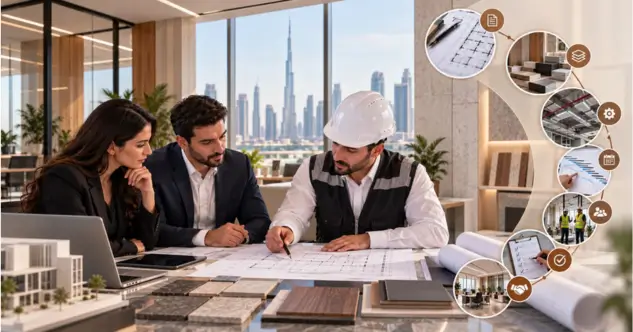
Choosing the right fit out contractors in Dubai and Abu Dhabi requires evaluating more than price or the appearance of completed projects. The contractor should have the technical capability, relevant project experience, and site management processes required to deliver the approved design according to project specifications.
According to Dubai Municipality, 23,270 buildings were under construction across Dubai in 2025, covering a total area of 40,028,453 square metres. These projects included investment and private villas, multi-storey buildings, public buildings, and industrial properties. With projects spanning different property types, selecting a contractor with experience relevant to the specific project is an important consideration.
According to G&M’s fit out experts, key factors to consider include:
- Relevant project experience: Review projects similar to yours in terms of property type, size, scope, and technical complexity.
- Technical capabilities: Assess the contractor’s ability to coordinate MEP systems, lighting, ceilings, partitions, joinery, finishes, and other technical requirements. Contractors with dedicated in-house MEP teams coordinate faster and resolve issues more efficiently than those who fully subcontract MEP works.
- Clear scope and quotations: Check that the proposal clearly defines included and excluded works, materials, specifications, responsibilities, and project requirements.
- Project management: Evaluate how the contractor manages schedules, procurement, suppliers, site activities, and communication throughout execution.
- Quality control: Understand how materials, workmanship, installations, and finishing details are inspected during the project and before handover.
- Approvals and compliance: Confirm that the contractor understands the relevant authority requirements, approvals, inspections, and project-specific compliance obligations for your location.
- Handover process: Review how final inspections, outstanding works, corrections, and handover documentation are managed.
When comparing contractors, it can also be useful to understand whether a single company handling both design and fit out works better for your project than appointing them separately. Our guide to interior design and fitout company vs separate contractors covers this in detail.
Common Mistakes to Avoid When Selecting a Fit Out Contractor

Selecting a fit out contractor without reviewing the details behind the proposal can lead to unexpected costs, delays, or differences between the approved design and final execution.
- Choosing based on price alone: The lowest quotation may not include the same materials, specifications, technical works, or responsibilities as other proposals. Compare the complete scope, not only the final price.
- Not checking relevant project experience: A contractor may have general construction experience without having completed fit out projects similar to yours in type, scale, or technical complexity.
- Accepting an unclear quotation: Unclear inclusions, exclusions, material specifications, or responsibilities can create disputes and additional costs during execution.
- Overlooking changes and variations: The process for approving design changes, material substitutions, additional works, and associated costs should be agreed before execution begins.
- Ignoring procurement lead times: Materials, custom joinery, fixtures, and other items carry different lead times. Failing to consider procurement early affects the project schedule in ways that are difficult to recover.
- Skipping licence and insurance verification: In the UAE, appointing an unregistered contractor exposes the client to regulatory risk. Under Law No. 7 of 2025, employers are prohibited from hiring unregistered contractors in Dubai. Confirming registration and insurance before appointment is not optional.
- Not defining quality and handover requirements: Inspection standards, outstanding works, corrections, and handover documentation should be clear before the project reaches its final stages.
Why Choose G&M as Your Fit Out Contractor?
G&M provides coordinated fit out solutions for commercial and residential projects in Dubai and Abu Dhabi, bringing together design, technical requirements, materials, and site execution within a structured project process. Each project is approached according to its specific scope, site conditions, functional requirements, and design direction.
- Integrated design and execution: Design requirements and site works are coordinated to maintain consistency throughout the project.
- Technical coordination: MEP systems, lighting, ceilings, partitions, flooring, joinery, and other interior elements are coordinated as part of the fit out process.
- Material and finish selection: Materials and finishes are selected according to design requirements, functionality, durability, and project specifications.
- Quality-focused execution: Attention is given to workmanship, installation, and finishing details throughout the project.
- Coordinated project delivery: Technical requirements, suppliers, materials, and site activities are managed through an organized process through to final handover.
Planning a fit out project in Dubai or Abu Dhabi? Explore G&M’s Interior and Exterior Design Services in Abu Dhabi and Dubai to develop a space that combines functional planning, coordinated execution, and integrated design.
Conclusion
Choosing the right fit out contractors in Dubai and Abu Dhabi requires more than comparing quotations. Relevant experience, technical coordination, a clearly defined scope, verified licensing, quality control, and effective project management all contribute to turning approved designs into functional, well-executed spaces.
Before selecting a contractor, verify their registration and insurance, review their capabilities, clarify project responsibilities, and ensure that requirements for materials, execution, variations, and handover are clearly defined. A well-coordinated fit out contractor can help keep the project aligned from initial site works through to final delivery.
FAQ
What do fit out contractors do?
Fit out contractors coordinate and execute interior works such as partitions, ceilings, MEP systems, lighting, flooring, joinery, finishes, and final handover according to the project scope.
How do I choose the right fit out contractor?
Consider relevant project experience, technical capabilities, scope clarity, project management, quality control, licensing status, and the contractor’s approach to approvals and handover.
What should be included in a fit out contractor’s quotation?
A quotation should clearly define the scope, included and excluded works, materials, specifications, responsibilities, costs, and any relevant project requirements.
What is the difference between a fit out contractor and a general contractor?
A fit out contractor focuses primarily on completing and coordinating interior spaces, while a general contractor typically manages a broader range of construction works depending on the project.
Do fit out contractors in Dubai need to be registered?
Yes. Under Law No. 7 of 2025, fit out contractors in Dubai must hold a valid commercial licence and be registered in the Dubai Municipality Electronic Register. Appointing an unregistered contractor is prohibited under this law.